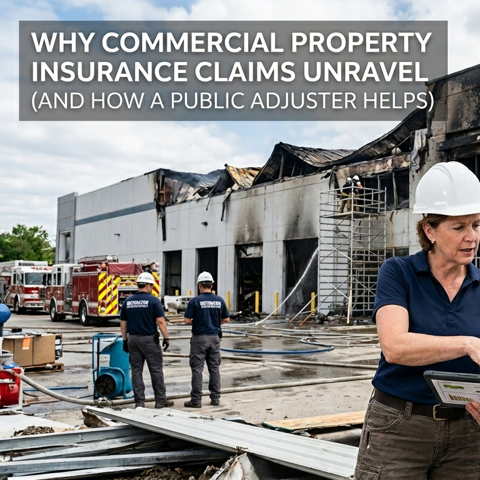
When a commercial property suffers hurricane damage, fire and smoke loss, flood intrusion, or another large-loss event, most owners assume the claim process will move toward a fair and complete resolution if they cooperate and respond quickly.
In practice, that assumption often fails.
A major property claim is not just a repair estimate. It is a documentation exercise, a valuation exercise, a coverage analysis, and, in many cases, a business interruption claim unfolding at the same time. That is precisely why so few claims are handled well the first time, and why hiring a public adjuster is often the single strongest step a policyholder can take to protect the outcome.
Is your commercial property claim already falling behind or facing delays? Don't navigate the complex insurance process alone. Call our team at 844.482.9093 or visit sill.com today for a free, no-obligation consultation.
The Loss Event Is Only the Beginning
A serious property loss rarely ends with the obvious damage visible on day one.
After a hurricane, a roof breach may lead to wind-driven rain intrusion, saturated insulation, concealed wall cavity moisture, damaged electrical systems, and interior finish failure. After a fire, the claim may extend far beyond charred materials into smoke contamination, corrosive residue, HVAC system impact, contents loss, and code-triggered rebuild requirements. Flood and water losses often develop into hidden migration, microbial growth, flooring failure, and structural drying complications if not properly scoped from the outset.
For a commercial building, multifamily property, HOA, warehouse, plant, school, or hospitality asset, the operational consequences are immediate. Occupancy may be reduced. Production may stop. Tenants may be displaced. Revenue can drop while payroll, debt service, and mitigation costs continue.
That is where many claims begin to break down. The policyholder is trying to stabilize operations while the claim is already being defined, limited, and valued in real time.
When disaster strikes your business, every hour matters. Let our financial and technical experts handle the heavy lifting while you focus on operations. Contact Sill Public Adjusters at 844.482.9093 or visit sill.com to protect your recovery.
Why Insurance Claims Commonly Go Off Track
Insurance carriers do not handle major losses through a single, simple decision. They rely on adjusters, consultants, engineers, estimators, accountants, and internal claim protocols. That process can produce legitimate reviews, but it also creates room for under-scoped damage, delayed approvals, depreciation disputes, and missed coverage positions.
The Scope Is Often Narrower Than the Damage
Early carrier inspections frequently focus on visible damage, not the full chain of loss. Secondary water migration, hidden contamination, ordinance and law exposure, specialty finishes, equipment calibration, and damaged contents can be minimized or omitted entirely if the policyholder does not build the record.
Business Interruption Is Commonly Underdeveloped
For many policyholders, the largest financial impact is not just physical damage. It is lost income, extra expense, relocation cost, delayed reopening, or impaired operations. Yet business interruption claims require disciplined financial support, historical earnings analysis, operational timelines, and a causal link. If that work is not done correctly, substantial value can be left behind.
Claim Handling Timelines Create Pressure
Property owners are often asked to make rapid decisions about mitigation, repair direction, inventories, and proofs of loss while the full damage picture is still developing. That pressure can lead to premature claim closure or acceptance of a scope that does not reflect the true loss.
If your insurance carrier is missing critical, hidden damage or underestimating your lost revenue, you need an advocate on your side. Call our experts at 844.482.9093 or visit sill.com to ensure your claim is valued correctly.
Why a Public Adjuster Is the Policyholder’s Best Asset
A public adjuster works for the policyholder, not the insurance company. In a large-loss environment, that distinction matters.
The job is not simply to “negotiate more.” It is to build the claim correctly from the ground up through forensic documentation, policy analysis, valuation discipline, and sustained claim management.
Building the Claim Before Arguing the Claim
A proper adjustment begins with a detailed scope-of-loss review, cause-and-origin support as needed, photographic and moisture documentation, contents inventory, and analysis of repair methodology. Hidden damage must be brought to light before it becomes a dispute over whether it was ever related to the event.
That work also includes identifying code-upgrade exposure, access limitations, demolition requirements, and the secondary conditions that often emerge after the first inspection.
Protecting Revenue During Recovery
For operating properties, the claim must address more than bricks, roofing, drywall, and equipment. A public adjuster helps organize business interruption worksheets, extra expense support, restoration timelines, and operational loss narratives so the claim reflects the full economic impact of the event.
This is how downtime is reduced, and continuity is protected. Recovery is not just about rebuilding the structure. It is about restoring the business behind it.
Fair Claim Resolution Requires Skilled Representation
The best insurance claim outcomes do not happen by accident. They happen when the policyholder has an experienced advocate managing the process, documenting every category of damage, and preventing the claim from being defined too narrowly in its earliest stages.
A fair resolution means the settlement reflects the full property damage, concealed conditions, code implications, contents impact, and income loss tied to the event. It means the policyholder has the funds and documentation necessary to rebuild correctly and resume operations without carrying the financial burden the policy was meant to cover.
Since 1928, Sill Public Adjusters has served property owners across the country in exactly these high stakes claim environments. If your hurricane, fire, flood, or large-loss claim is not being handled the way it should be, call our team at 844.482.9093 or visit sill.com.