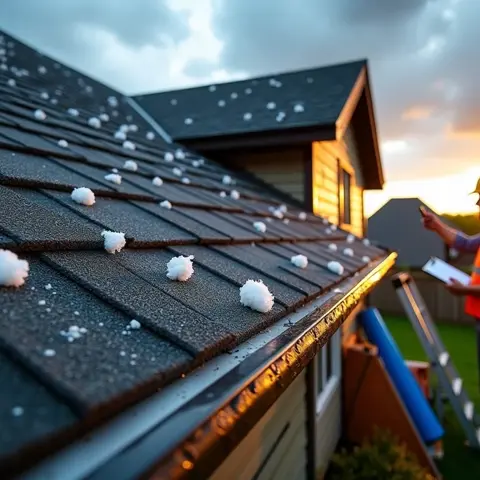
A public adjuster can turn a disappointing insurance settlement into fair compensation after storm and hail damage strikes your property. Most homeowners accept their first offer without realizing they're entitled to significantly more. Storm and hail claims are notoriously complex and frequently underpaid by insurance companies. Damaged roofs, dented siding, and hidden structural issues often go undetected or undervalued during standard inspections.
This guide explains why partnering with Sill Public Adjusters is the most critical step you can take to assess damage comprehensively, identify hidden coverage, and negotiate aggressively for the settlement you deserve.
Understanding Storm and Hail Damage Insurance Claims
Hailstorms and severe weather cause diverse destruction to residential and commercial properties. Roof damage tops the list, ranging from cracked or missing shingles to complete structural failure. Hail strips protective granules from roofing materials, accelerating deterioration and leaving your home vulnerable to water infiltration long after the storm passes.
Siding takes direct impact from hailstones, causing dents, cracks, and breaches that compromise your home's exterior envelope. Windows and doors suffer seal failure, frame distortion, and glass damage. Gutters, downspouts, and HVAC equipment are frequently damaged but routinely overlooked during standard insurance inspections.
Is your settlement falling short of the actual damage? Call Sill Public Adjusters today at 844.650.7455 for a professional assessment.
Why Storm and Hail Claims Are Often Underpaid
Insurance companies employ strategies that systematically reduce settlement amounts. Adjusters may conduct brief inspections for missing damage in hard-to-access areas like attics, high rooflines, and wall cavities. They frequently rely on visual assessments without specialized equipment to detect underlying moisture or structural compromise.
Depreciation Calculations: Insurers often apply "Actual Cash Value" rather than replacement cost, deducting for age. A ten-year-old roof receives substantially less compensation than the actual cost of replacing it.
Scope Disputes: Company adjusters frequently attribute destruction to "pre-existing conditions" or "normal wear and tear" to avoid paying for storm-related repairs.
Generic Pricing: Insurers use standardized software to calculate costs, often ignoring the rising price of local labor and materials following a major storm event.
The Challenge of Proving Hail and Storm Losses
Documentation requirements create significant obstacles. Hail, high winds, and rain often occur simultaneously, making it difficult for an untrained eye to attribute specific damage to a covered event. Physical evidence also disappears rapidly — rain washes away debris patterns, and emergency repairs, while necessary, can inadvertently obscure proof of the original loss.
The burden of proof rests entirely on the policyholder. You must demonstrate that covered storm damage occurred and prove the necessity of every repair. Without technical expertise in building science and the professional backing of a firm like Sill, gathering sufficient evidence is nearly impossible for most property owners.
Don't let the insurance company dictate the value of your loss. Contact Us to sign up for a comprehensive policy review.
Why the Right Advocate Matters: Public vs. Company Adjusters
Licensed professionals who work exclusively for policyholders, public adjusters level the playing field. While company adjusters work for the insurer, the team at Sill handles every aspect of your claim with your best interest in mind.
The primary difference lies in loyalty and motivation. A company adjuster is employed by the insurance corporation; their goal is cost control. They often handle a high volume of claims, resulting in brief, surface-level inspections.
When you sign with Sill, you are hiring an advocate whose loyalty is strictly to you. Our primary goal is your maximum financial recovery. We invest significant time into thorough investigations to ensure no damage is overlooked, and we interpret complex policy language to identify all applicable coverage — including "Law and Ordinance" upgrades and "Additional Living Expenses."
How Sill Maximizes Your Storm and Hail Settlement
Strategic property evaluation separates Sill from standard inspections. We spend hours examining every component, utilizing advanced technology to build a bulletproof claim.
Advanced Forensic Tools: We use infrared cameras to reveal hidden leaks and moisture meters to detect water intrusion inside wall cavities that the naked eye cannot see.
Accurate Repair Cost Estimation: We obtain multiple contractor bids that reflect real-world market rates and local labor costs rather than insurance software averages.
Identifying Secondary Damage: Our experts trace secondary effects — such as granule loss that leads to premature shingle failure or attic insulation saturation discovered weeks after the initial storm.
Aggressive Negotiation: We submit detailed rebuttals to inadequate offers, citing policy language and forensic evidence that contradict the insurer's lowball figures.
Protect your property's value. Call Sill Public Adjusters today at 844.650.7455 to ensure your claim is handled correctly from the start.
Take the First Step Toward a Fair Recovery
Maximizing your storm and hail damage settlement requires expertise, technology, and persistence. Insurance companies prioritize their bottom line — having an advocate who works exclusively for you makes all the difference. When you sign with Sill, you are choosing a licensed professional with specific experience in major hail and storm damage claims across the country.
Take the first step toward a fair recovery. Call Sill Public Adjusters today at 844.650.7455 or visit Contact Us to sign up for a policy review.